Confederate Money Value
By Money Scanner ·
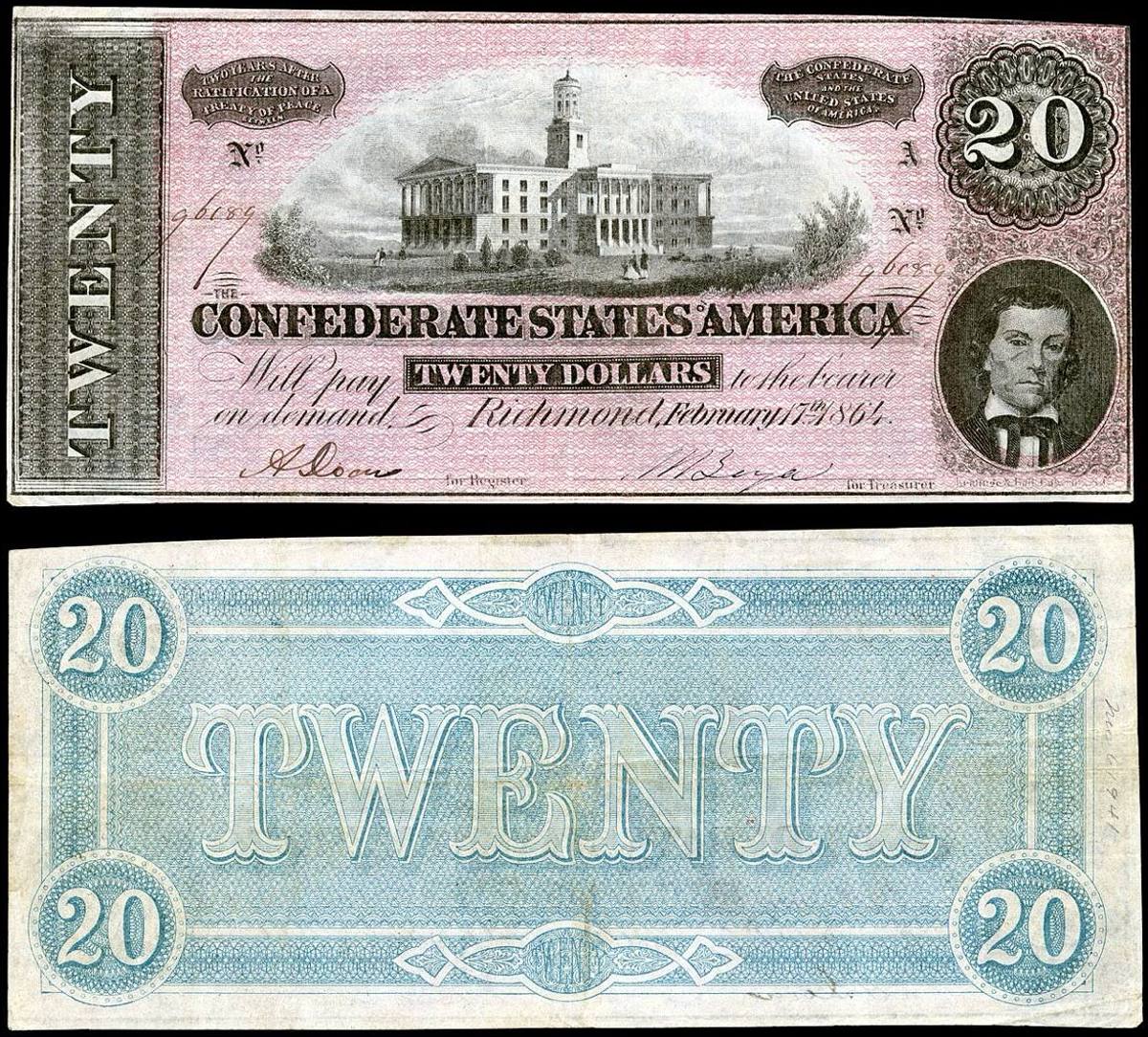
Most Confederate money that comes out of family papers is one of two things: a genuine 1864 note worth somewhere between $12 and a few hundred dollars, or a reproduction worth nothing. The second is far more common than people expect, so this page starts with the test, not the price list.
The Confederacy issued roughly $1.7 billion in paper across seven series between 1861 and 1864, according to Wikipedia's history of the Confederate dollar. The last series alone ran past $400 million. That volume is why a real 1864 $10 is cheap, and why a real 1861 Montgomery note is not.
Real or reproduction: check this before anything else
Planet Banknote's Confederate currency guide gives the cleanest tests, and they hold up. Genuine notes above 50 cents were signed by hand, in ink, by clerks. The serial number was also written by hand, usually in the same ink. Sheets were cut apart with scissors, so the margins wander.
A reproduction prints everything. The signatures are part of the design, the serial is printed, and the edges are machine straight. Reproduction batches also reuse serial numbers, so if you have two notes with the same handwritten looking serial, they are copies.
| Check | Genuine note | Reproduction |
|---|---|---|
| Signatures | Hand signed in ink, brown or reddish brown with age | Printed, often solid black |
| Serial number | Handwritten | Printed, repeated across copies |
| Margins | Uneven, scissor cut | Even, machine trimmed |
| Back, lower left | No extra text | Sometimes tiny FACSIMILE |
Tests from Planet Banknote's Confederate currency guide and collector reports gathered by Collectors Weekly.
Why so many copies exist
The fakes started during the war. A Philadelphia shopkeeper, Samuel C. Upham, sold facsimile Confederate notes as souvenirs with an advertising line printed in the bottom margin. Buyers trimmed the margin off and spent them in the South. PMG reports Upham claimed 1,564,000 pieces between March 1862 and August 1863. An intact Upham with its margin is now collectible in its own right.
A century later came the souvenir packs. Collectors Weekly readers describe sets sold at historic sites and in cereal promotions in the 1950s for about a dollar. Those are the notes with printed signatures and perfect edges that most families have. They are worth what the paper weighs.
What genuine 1864 notes sell for
The February 17, 1864 series (types T-64 through T-72) is what most real notes turn out to be. The ranges below are CDN Greysheet CPG retail, from a worn note at the low end to a gem at the high end. A few of the ceilings look strange, such as $4,000 for the $10, because they come from rare varieties within the type, not the common note.
| 1864 type | Denomination | Greysheet range |
|---|---|---|
| T-64 | $500 | $175 to $36,000 |
| T-65 | $100 | $35 to $1,200 |
| T-66 | $50 | $30 to $700 |
| T-67 | $20 | $20 to $400 |
| T-68 | $10 | $12 to $4,000 |
| T-69 | $5 | $18 to $800 |
| T-70 | $2 | $20 to $5,000 |
| T-71 | $1 | $30 to $8,000 |
| T-72 | 50 cents | $18 to $450 |
CDN Greysheet CPG retail, Confederate States 1864. Planet Banknote puts a common T-68 $10 at about $20 in VG and $85 uncirculated.
Sorting a family stack
Confederate notes usually turn up in groups: a bundle in a Bible, an envelope of souvenirs, a frame from a grandparent's wall. Sort them before you price anything, because one genuine note in a pile of copies is common, and so is the reverse.
First pass: signatures. Put every note with printed signatures in one pile. Those are reproductions until proven otherwise, and they almost never are. Second pass: dates. Most genuine notes say February 17, 1864. Anything dated 1861 goes in its own pile for a closer look, since that is where the expensive types live. Third pass: condition. Separate notes with no folds from the rest, because those are the only common types where grade moves the price into the hundreds.
Keep the notes flat in paper money sleeves while you do this. Do not tape tears or press out folds. A genuine note with honest wear sells; a repaired one sells for less, and the repair is easy for a dealer to spot.
Real auction numbers for the common types
Greysheet's item pages list PMG graded sales that show where the market actually trades. A T-67 $20 brought $149 in Choice VF35, $119 in AU55, and $159 in CU63. A T-69 $5 sold for $106 in AU58 and $439 in Gem 65 EPQ. A T-68 $10 brought $139 in CU64 and $1,281 in Gem 66.
The pattern is the same across the series: a grade jump from 64 to 66 can multiply the price, while circulated notes stay in the tens of dollars. A worn T-68 with a tear is a $12 to $20 note however old it is. For what the grade numbers mean, see our banknote grading scale.
The notes that are actually rare
The first Confederate notes were issued in Montgomery, Alabama in March 1861: interest bearing $50, $100, $500, and $1,000 notes, only $2 million in total. Planet Banknote cites 607 each of the $500 and $1,000 and 1,606 each of the $50 and $100.
Greysheet prices the Montgomery T-1 $1,000 at $12,000 to $42,500, T-2 $500 at $6,000 to $37,000, T-3 $100 at $4,000 to $28,000, and T-4 $50 at $4,000 to $22,000. Other 1861 issues are expensive too: the T-35 $5 runs $5,500 to $42,000 and the T-27 $10 $4,000 to $28,000.
If your note says Montgomery and passes the tests above, stop handling it and contact an auction house. If it says Montgomery and has printed signatures, it is one of the most copied notes ever made.
How condition is judged on Confederate notes
The grade scale is the same one used for federal notes, from Good through Gem Uncirculated, but the paper was poor and the cutting was rough, so graders allow for things that would count as defects on a modern note. Uneven margins are normal. Ink signatures that have faded to brown are normal.
What still costs money is the usual list: folds, tears, holes, stains, missing corners and pieces trimmed off into the design. The PMG prices above show what that means in practice. A T-69 $5 at AU58, a note with only light handling, sold for $106. The same type in Gem 65 brought $439. Four times the price for a note that looks almost the same to most people.
If you have a note that might be uncirculated, grading through PMG or PCGS is worth the fee for the 1864 $10, $20 and $5 at that level, and for any 1861 note in any condition.
Cancelled notes
Many notes were cut cancelled when they were redeemed: a series of slits or a cut through the center or the signatures. Pierre Fricke's catalog, the standard reference, prices cancelled notes in their own column below uncancelled ones. They are genuine and collectible, just worth less. Nobody publishes a fixed discount, so get comparable sales for your exact type before you price one.
Where to sell a genuine note
Common 1864 notes in circulated grades sell well on eBay and to local dealers, usually near the low end of the Greysheet range. Uncirculated notes and anything from 1861 belong at an auction house that runs paper money sales, ideally after grading. Our guide to selling old paper money walks through fees and timing.
Frequently asked questions
How much is Confederate money worth?
Genuine 1864 notes, the most common, sell for about $12 to $40 in circulated grades and a few hundred dollars uncirculated. 1861 Montgomery notes start in the thousands. Reproductions have no collector value.
How can I tell if my Confederate money is real?
Look at the signatures and serial number. On genuine notes above 50 cents both were written by hand in ink. Printed signatures, a printed serial, perfectly straight edges, or FACSIMILE on the back mean it is a copy.
Is a Confederate $100 bill worth anything?
A genuine 1864 $100 (T-65) has a Greysheet range of $35 to $1,200 depending on grade. Earlier $100 types are worth more, and the 1861 Montgomery $100 starts around $4,000.
Are cancelled Confederate notes worth less?
Yes. Cut cancelled notes are genuine but trade below uncancelled examples of the same type. Fricke's catalog prices them separately.
Sources
Scan any banknote with Money Scanner
Point your camera at a bill and get the series, type, rarity, and an estimated value range in seconds. No typing, no guessing at the series letter.
- Reads the series, seal type, and signatures from a photo
- Flags star notes and collectible serial number patterns
- Estimates a value range by condition
- Works on US and world banknotes